Web Crawling
The built-in crawler discovers and ingests linked pages starting from a URL you provide. Crawled pages keep their source URL, so answers cite and link back to the original website — like a search engine.
Starting a crawl
- Open your project's Materials page.
- Enter the starting URL.
- Choose a crawl scope (see below).
- Click Start Crawl. Crawling runs asynchronously; pages appear in your materials as they are ingested.
Crawl scopes
- Equal and Below (recommended default) — restricts crawling to pages whose URLs begin with the starting point. For example,
nasa.gov/blogstargets all blog entries (likenasa.gov/blogs/new-rocket) but not unrelated paths such asnasa.gov/events. Like following one branch of a tree without jumping to another branch. - Same Subdomain — crawls all pages within a specific subdomain. Choosing
docs.nasa.govexplores everything under that subdomain, ignoringnasa.govorapi.nasa.gov. Like confining yourself to a single section of a library. - Entire Domain — crawls the main domain including all its subdomains:
nasa.govincludesdocs.nasa.gov,api.nasa.gov, and so on. A pass to every room in the building. - All — the most extensive option: the crawler starts at your URL and follows links anywhere, potentially beyond the initial domain. A web expedition with no boundary.
Start narrow
Broad scopes tend to ingest navigation boilerplate and off-topic pages, which dilutes retrieval quality. Start with Equal and Below and re-run with a broader scope only if you need to.
How crawled content is stored
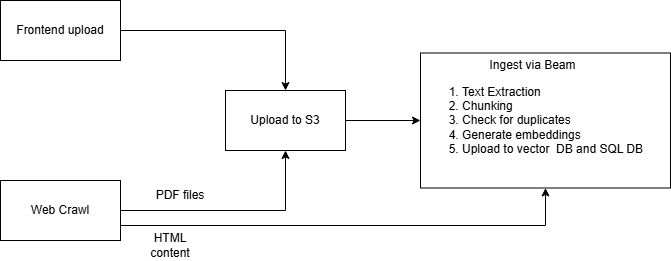
- HTML pages — visible text is extracted and stored directly in the database (not object storage), with the source URL preserved for citations.
- Files found during the crawl (PDF, Word, PowerPoint, Excel) — uploaded to object storage as a backup, but citations still link to the original source; the local copy is used as a fallback if the original goes missing (404).
Under the hood
Crawling is powered by Crawlee with Playwright, running as its own service (apps/crawlee in the monorepo). It is fast — crawls have been observed at 10 Gbps using six cores of parallel JavaScript — and cheap to host.